


A few years ago, while I was clearing out my mum’s house, I found some rolls of undeveloped film.
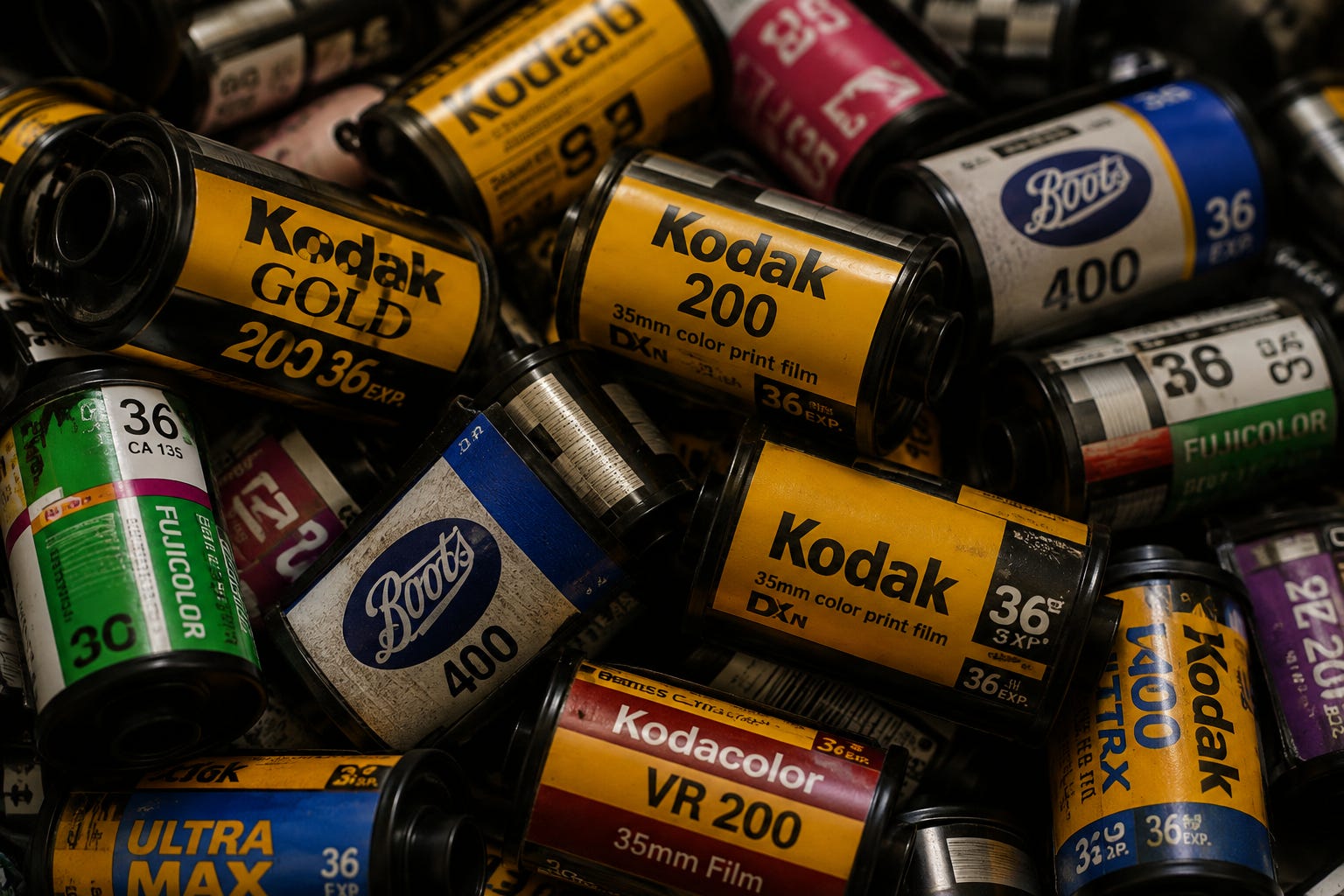
Some of them must have been 20 years old.
If you’re anywhere around my age, you’ll remember this scenario perfectly well. You took your photos on your old camera, dropped the film off at Boots, waited however many days it took, then went back to collect an envelope full of prints, half of which were usually rubbish.
You might sit around with the family and flick through them once, perhaps order a couple of duplicates for Auntie Margaret, then they’d get shoved into a drawer or a box somewhere and quite possibly never looked at again.
That was about the extent of photo sharing ‘back in our day!’
We didn’t document our breakfast, tell 4,000 people we were having a difficult day or take everyone on holiday with us in real time.
We came from a very different world.
Children should be seen and not heard. Your diary came with a tiny lock and key (remember them), because the entire point was that nobody else was supposed to bloody read it.
If you wanted to speak to your best friend, you rang her house, had to get through her mum first and then spent the call listening for the little click that meant someone had picked up the other phone.
And in our house, one of my mum’s favourite sayings was:
“Never hang your dirty washing out in public.”
Which makes building a personal brand in 2026 quite interesting.
When did we all start sharing so much?
Over the last decade or so, vulnerability has become a huge part of how we communicate online.
Brené Brown undoubtedly had a lot to do with bringing the conversation around vulnerability and shame into the mainstream, and I think much of that has been incredibly valuable. There’s something enormously powerful about realising that we don’t have to pretend everything is perfect all the time.
But, as tends to happen with these things, the pendulum swung quite a long way.
Somewhere along the line, being authentic online started to feel as though it meant telling people everything.
Your fears. Your relationships. Your childhood. Your trauma. Your insecurities. Your family problems. The thoughts you had at 3.17am when you couldn’t sleep.
And if that’s how you like to write or create, brilliant. There are people who are extraordinarily good at it, and clearly there are millions of readers who love that level of openness and connection.
I’m just not sure I’m one of the people who wants to create that way.
I love telling stories. I love sharing my life, my travels, the silly things I do, the businesses I’m building, the things I’m struggling with and the stuff I’m learning as I go.
But there’s a point where my brain goes...
Nope. That’s TMI.
And I’ve been thinking about this quite a lot recently because I’m trying to become a better writer and creator, and inevitably that means letting people get to know me.
As we know people connect with people.
I get that much.
But how much of yourself do you actually have to hand over?
My Uncomfortable Post
A couple of weeks ago, on the anniversary of my mum’s death, I wrote a short post about her.
It wasn’t wildly revealing. Most of us reach an age where we’ve lost people we love, and there was nothing particularly unusual about what I shared.
But I still felt uncomfortable posting it.
Partly because it was personal and partly because I wondered what on earth it had to do with The 50+ Nomad.
Why was I telling strangers on the internet about my mum?
If I’m completely truthful, I think part of the reason I posted it was because I’ve spent so much time consuming other people’s content that I’d started to think perhaps this was what I was supposed to do.
Be more vulnerable. Let people in. Show more of the person behind the brand.
And there is some truth in that.
(Plus she did pass on some great truths that I shared in the note - with a touch of humour - more on that below!)
But I also realised that I don’t want to start mining my private life for content simply because personal content performs well.
There has to be another way.
And I think there is.
6 Ways to Be Personal Without Making Everything Public
I’ve been thinking about the different ways I’m comfortable letting people get to know me without feeling as though I’ve handed them the key to my diary, and how I can bring more of myself into my writing while still keeping the things I want to keep private.
These are the six approaches that feel right for me.
1. Put a funny spin on it
Humour is probably my favourite way of being open about something without making it feel too heavy.
Demonstrated perfectly by the note about my Mum.
Losing my mum was obviously not funny, and I would never try to make it so, but even in a post that personal, I found myself adding a little humour.
I shared three things she used to say to me, including this last one, with the little joke about my husband that made the post feel much more like me.
“❤️ And my favourite (not my husband’s)… “It’s only money.” 😂”
And yes she really did used to say to me ‘it’s only money Jo’.
Quick digression - many years ago we went to Rome together and one afternoon we decided to order a bottle of wine with our meal. We didn’t look at he price and nearly fell over when 75 euros was added to the bill! But my lovely Mum, god rest her soul, just smiled and said ‘never mind, it’s only money’. 🥰
Of course, some things are simply too painful, too raw or too serious to find anything remotely funny about, and if you choose to share those things, humour may have no place in them.
But when it does feel natural, I think humour can be a lovely way of letting people into something personal without feeling as though you’ve suddenly stripped yourself emotionally naked in front of the internet.
2. Share the scar, not the wound
I heard Amy Porterfield say this years ago and it’s always stuck with me.
You don’t have to share something while you’re slap bang in the middle of it.
Sometimes we need to live through something first, figure out what we think about it, talk it through with people we love (if relevant), and only then decide whether there’s something useful in it for somebody else.
My burnout after our biggest ever year in business in 2016 is a good example.
I talk about it quite openly now, but I couldn’t for a long time because I hadn’t made sense of it myself.
We’d had our most financially successful year ever and yet I was completely burnt out and deeply unhappy with the business I’d built. It took me a long time to understand what had happened and why.
But now I can (and do) talk about it because the experience contains a useful lesson.
(In summary - If you build purely for money while spending your days doing something you don’t enjoy, there’s a fairly good chance that at some point the money won’t be enough, and you’ll burn out. )
I couldn’t have articulated that while I was going through it.
Ten years later, I can.
3. Be open about the smaller stuff
I’m quite happy telling you that my menopausal brain occasionally seems to have left the building.
I’ll talk about feeling overwhelmed, procrastinating, getting something spectacularly wrong, being nervous before doing something new, wondering what the hell I’m doing with my business or discovering that I am considerably less fit than the mountain I’ve decided to climb requires.
Those things are personal, but not gut wrenchingly so.
They’re still real.
And often they’re the things people relate to most because we’ve all got our own similar version of them.
4. Let people know what you think
You can reveal an enormous amount about yourself without revealing your deepest secrets.
What makes you laugh?
What annoys you?
What do you believe about getting older, travelling, money, ambition, freedom, starting again or how we should spend the relatively short amount of time we get on this planet?
Your opinions and the way you view the world tell me who you are.
You don’t need to share your deepest secrets simply because you feel like that’s what you’re ‘supposed’ to do.
5. Point the camera outwards sometimes
One of the things I love most about travelling is other people.
The random woman I met in a wine bar in Times Square and talked to for over an hour. The people I meet on buses and tours and hikes. The cultures, conversations, food, places and little moments that make travelling endlessly fascinating to me.
There’s a whole world out there to write about.
Your content doesn’t always have to involve staring deeply into your own navel.
6. Decide what belongs to you
I still wrestle with this a little.
There are things I’ll happily tell thousands of strangers and things I barely discuss with friends.
There are stories involving other people that aren’t mine to tell.
There are things I might write about one day but wouldn’t dream of sharing now.
And there are parts of my life that will probably never become content at all.
I’m increasingly okay with that.
I don’t think building an audience means continually pushing yourself to reveal more and more. I think it means letting enough of yourself into your work that people start to recognise you in it.
Your humour, opinions, values, and quirks. The fact that you love Marmite, rollercoasters and Linkin Park, have strong opinions about which way a bed should face, and think cold baked beans, cheese & mayo sandwiches are a perfectly acceptable food choice. (Yep I said it!)
Over time, people get to know you through all of those little pieces.
You can be open without being an open book.
And for those of us raised on locked diaries, shared house phones and mothers warning us about dirty washing, that feels considerably more doable.
I’d love to know where your line is.
Are you comfortable sharing the deeply personal stuff online, or does your inner Gen Xer immediately reach for the tiny lock and key?
Confessional poets and memoirsts and autobiographical novelists have spilled their guts for a long time...but artfully, in a way that it's so personal that paradoxically it is universal. I've always looked to literature for this sense of how humans get through this life and then write about it in such a powerful way.
I was discussing a personal happening in my life with one of my sons. It is a defining thing in my life and we were talking about how much of it should or could show up in my writing. His advice was, “it doesn’t have to all come out at once; you can disclose it over time.” I appreciated his wisdom and it matches up with what you are saying.