


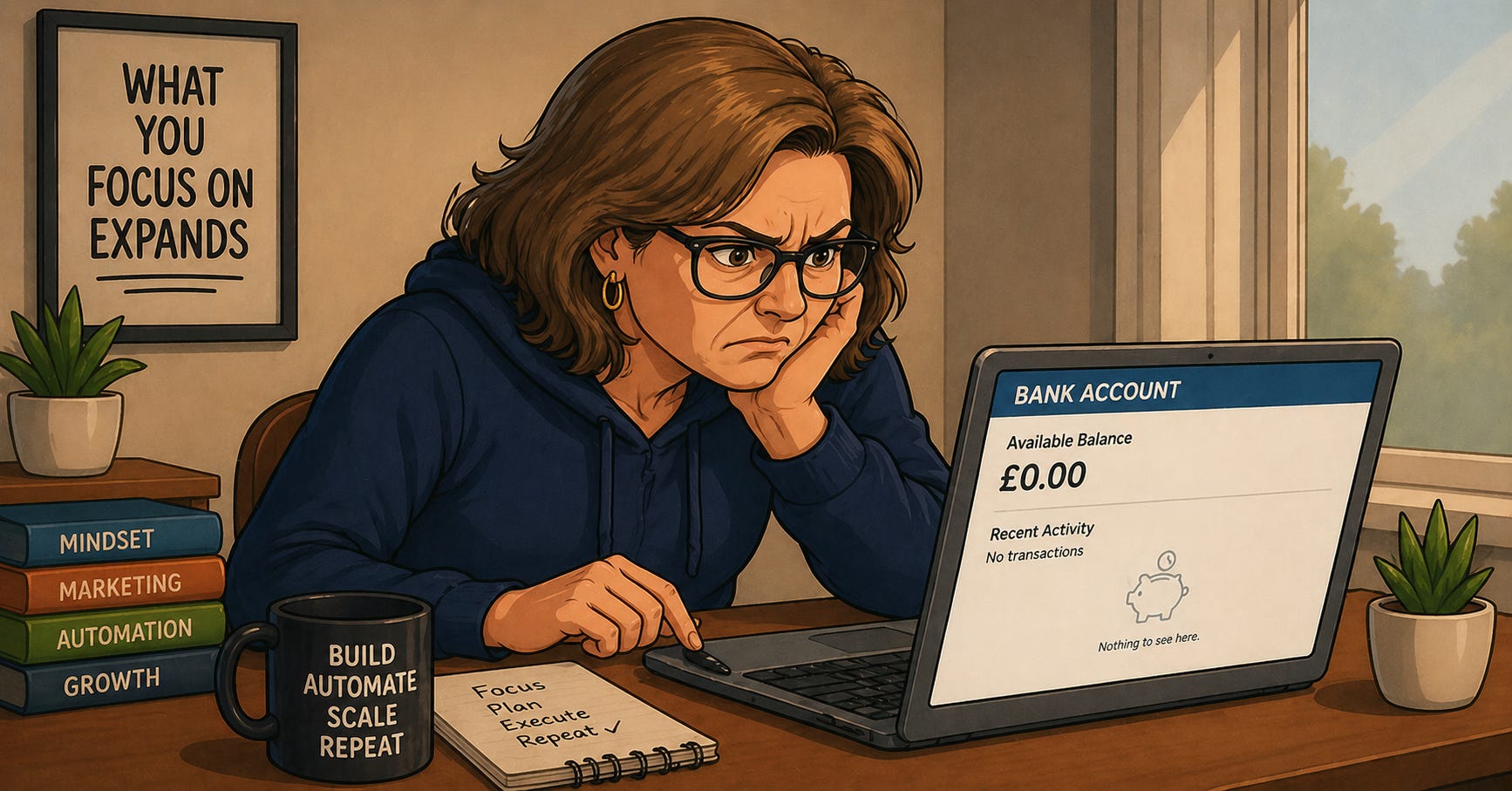
For years I’ve been parroting the line every self-help guru peddles: the only real barrier to success is mindset. Fix your head, the rest follows.
I’ve said it on webinars, in Substack notes and articles. I’ve said it in workshops. I’ve probably said it to you.
But I want to take some of it back.
Not all of it. Mindset matters.
It’s the reason I got on a plane sixteen years ago with my husband and a laptop and never really went home. It’s the reason I’m writing this from a café in Colombia instead of a desk in Sheffield.
But somewhere along the way the industry I work in turned a useful idea into a lazy one. I went along with it, and I think it needs a reframe.
Here’s what made me question it.
Last week I spent hours fighting with Facebook ads for my travel cards. Clicking things that wouldn’t click. Watching spinners spin. Re-reading the same help article four times and still not understanding what it wanted from me.
By the end I’d lost the morning and made zero progress, it was frustrating to say the least.
And I’m a pretty techy person. I’ve used Facebook for years. I started to think - if someone just getting started was going through this experience they’d immediately feel that this online business stuff is way too hard!
Now that could be seen as a mindset problem. Surely if you want it bad enough you’ll do whatever it takes to figure it out, right?
Except Facebook’s ads platform is genuinely, teeth-grindingly difficult, and most beginners don’t have a spare £5k hanging around to hand it to someone who speaks fluent Meta.
That’s not a mindset gap my friend. That’s a resource gap.
And labelling it as just mindset keeps you stuck blaming yourself that you can’t make it work.
A physical example of a similar issue.
I have knee arthritis. I can walk, I can exercise, I can do glute bridges on my hotel floor. But I could plaster every wall in this apartment with affirmations and it still won’t mean I can run an ultra marathon and walk the next day.
There’s a physical limit that no amount of positive thinking can override.
Mindset gets me to the starting line. It doesn’t run the race.
Which is when I started seeing it everywhere.
My new ecom brand launched in January. I missed the Christmas gifting window by a whisker, and now I’m staring down eleven months of grinding sales on a product that’s fundamentally giftable, until Q4 rolls back round.
Is that a mindset problem? Or is it a timing problem that will be solved by a calendar, not a mantra?
Five walls, not one.
Here’s a useful reframe.
When you hit a wall, stop asking “do I have the right mindset?” and start asking “what kind of wall is this?”
Because different walls need different tools, and treating all of them as mindset problems is why we end up exhausted and still stuck.
Mindset Walls
Fear
Avoidance
Perfectionism
Imposter Syndrome
The story you tell yourself about what people like you can and can’t do
Mindset work genuinely shifts these.
Therapy helps (as does wine).
Reading Brené Brown at 3 in the morning is a solid option.
This is the wall the gurus focus on, and it’s the one where mindset work can genuinely make a difference.
Skill Walls
You don’t know how to do the thing.
My Facebook ads morning was this. No amount of positive thinking teaches you how to structure a campaign. You learn it, you hire it, or you abandon it.
Sticking notes on a mirror that read ‘I do understand FB Ads’ is not the answer.

Resource Walls
Time, money, energy, health, a working laptop.
Someone with an identical mindset to yours but a spare $10k for a PPC agency will get a different result.
That’s not weakness of will. That’s arithmetic.
Timing Walls
My cards missing Q4.
A product launched into a recession.
A pitch made the week your industry imploded.
The fix is patience or pivoting, not pushing harder into a headwind.
Luck Walls
The algorithm changed.
The journalist didn’t reply.
The investor had a bad morning.
You can’t mindset your way to luck. You can only keep taking shots so you’re in the room when it shows up.
Where the ‘Self Help’ Industry Has It Wrong
The self-help framing neatly collapses all five walls into the mindset one.
If you succeed, growth mindset. If you fail, fixed mindset.
It’s a closed loop that can’t be wrong, and it’s designed that way, because a framework that can’t be falsified is a framework that can sell forever.
If you’re the person I most often picture reading this — 50+, accomplished, brilliant at your old career, still trying to crack a location-independent income after a couple of false starts — this is so important because you’ve probably been blaming your mindset for things that aren’t your mindset’s fault.
The course that didn’t convert? Might be a skill wall around sales pages.
The consulting idea that stalled? Might be a timing wall because your network hasn’t caught up with your pivot yet.
The podcast you keep not launching? Might be a resource wall because you’ve got three care responsibilities and four hours of spare time a week.
None of these are fixed by waking at 5am and journaling your intentions. They’re fixed by naming the right wall and choosing the tool that matches it.
So Mindset Doesn’t Matter?
Not even close. Mindset is the thing that underpins all of this.
You need it to sit down and learn the skill you’re missing.
You need it to look at the resource gap and get creative instead of defeated.
You need it to wait out the timing wall without quietly giving up.
You need it to keep showing up on the days when luck has clearly left the building.
Mindset is what stops you walking away from the wall entirely and keeps you standing there long enough to figure out which tool you actually need.
But that’s different from what the self-help industry sells.
They sell mindset as the destination. Fix your thinking and the rest just sort of... unfolds.
Write your goals on a mirror. Visualise the bank balance. Repeat affirmations in the shower until you believe them.
And it works brilliantly, for the people selling the course.
Because when it doesn’t work for you, the diagnosis is always the same: you didn’t believe hard enough. You didn’t commit. You let limiting beliefs win. Which conveniently means you need another course, another programme, another £297 masterclass on rewiring your subconscious.
It’s genius, really. A system that explains away its own failures will never run out of customers.
Meanwhile, the person who’s been journaling their intentions for six months and still can’t grow their Substack starts thinking there’s something fundamentally wrong with them.
There isn’t.
They might need to learn how headlines work, or how the algorithm decides what to recommend, or why their welcome email reads like a terms and conditions page. Those are learnable things, not character flaws.
If you’re reading this, you’ve already got grit. You’ve raised families, built careers, navigated redundancies, bereavements, the lot. You didn’t get to 50-something by lacking resilience.
The idea that you need to unlock some deeper level of mental toughness before you can build a side income is, frankly, insulting (and probably keeping you stuck).
But what you might need is a different skill. Or more time. Or a better strategy. Or to wait for the right window. Or to try seven things so that one of them catches.
So next time you’re stuck, try the diagnostic instead of the affirmation. Ask yourself: what kind of wall is this? Mindset, skill, resource, timing, or luck? Be honest about it. Then spend your energy on the fix that matches.
The self-help industry has been selling one tool for every job. I’ve done it too. But you wouldn’t use a hammer to change a tyre, and you shouldn’t use a mantra to solve a skills gap.
Mindset keeps you in the game. But it was never meant to be the whole game.
If this resonated, forward this to the friend you keep telling to “just believe in herself.” They probably need a map, not a mantra.
For less than a questionable airport sandwich, you get full access to The Backpack ($500+ value), members only chat, and our monthly live calls. Everything you need to start building portable income and making these your best years yet.
I was happy to read this, Jo. I’m a great believer in having or developing the right mindset but when someone posted the other day “Attitude is everything”, in reply to something I had posted, I wanted to say “Noooo! Not everything!
You have explained why in great detail here. 😃
As stated in the book You Can Do It! El último empujón a tu inglés, “to achieve success in any endeavor, you need the ‘right mindset’ + the ‘right method’.”
OMG! I recently got into a battle with FB ads that took me hours, and it still isn't "fixed". I read everything I could find, and nothing worked. Finally, I found something that showed me how Meta likes to change things without warning, and that told me that I'm stuck in a glitch. So, I found a workaround and am using it.
I truly appreciate this article because, as a 50+'er, I am pretty tech-savvy as well. Yet, I felt so frustrated and STUPID. Let's say it how it felt.
Ultimately, the mindset is the basis of my pushing forward and not being willing to give up (stubborn?). But that mindset did lead me to a solution.
I appreciate the acknowledgment that my mindset can't solve all things. I must keep learning and growing, even in unexpected ways. Even about things I think I know.
Being willing to admit this. Being willing to stop and look for different answers. That is the mindset that leads to success.
Thanks so much for writing this. I think the timing of this post landed perfectly for me.