



I’m ‘writing’ this article from the passenger seat of our car.
We’re winding our way through the Rockies in British Columbia, and I put ‘writing’ in inverted comments because as a full time nomad, where time is of the essence, I mainly talk my articles into a cool app called Letterly.
Letterly then transcribes my garbled thoughts into Claude, which takes the thoughts and structures them into something resembling an article.
Once I land wherever we’re going, I can read through my post, edit where appropriate and Bob’s Your Uncle - here’s the result.
But this week I did something even more ambitious. I built a digital product while on the move.
I took a version of this article you’re reading now, (in other words my first draft which was way too long and way too tactical), and turned it into a saleable step by step guide which is now live and on sale on Gumroad.
All from a moving car!
Because that’s the beauty of the world we live in now. You don’t need a business, a website, a warehouse, or even a desk and a chair to start funding your freedom.
What you need is a few small assets, built once and put out into the world, and a growing audience of people you can genuinely help and add value to.
That’s exactly what I’m doing from this car seat. And by the end of this post, I’d like you to see that you could be doing it too.
I Struck Gold!
I still remember the first digital product I ever sold. (I went hunting for it on Dropbox the other day and unfortunately couldn’t find it, though I turned up plenty of others.)
It was a $7 PDF, explaining, with screenshots, how to create a landing page on Aweber - a process I’d watched somebody else do in a video. I wrote up what I’d learned, put a price on it, and made $28.
You’d have thought that I’d struck gold!
Don’t get me wrong, $28 wasn’t going to get me very far, but the realisation that people would pay me money over the internet for something I’d created myself was like rubbing Aladdin’s magic lamp!
I was beside myself!
Later the same year, I made a video course called ‘2000 Fans in 28 Days’ (I was teaching Facebook Fan Pages at the time), which went on to earn around $30,000.
A few months later I launched the Social Networking Academy and did $117k in 7 days (see my origin story below) and the rest as they say is history.

But the key takeaway here is that all of it started with a $7 guide about a landing page hack.
It’s Never Been Easier Than Right Now
When I started out in 2010, creating a digital product, hosting it and telling the world about it was infinitely harder than it is today.
There was no google docs, no YouTube embed, no Claude or ChatGPT, no Canva, no Substack.
I built my audience through forums, literally hand coded landing pages, and have absolutely no memory of how I delivered the PDF (but somehow I did!)
These days we have no such excuse. We can record a video on our phone and upload it in minutes, design a planner in Canva, publish a journal on Amazon, even sell physical products without touching a box thanks to print-on-demand.
Yes that means there’s more noise and competition, but it also means it’s easier than ever to try.
Just to give something a go to see if it’ll fly.
Which is exactly why I love digital products as brilliant little micro hustles. They’re light, flexible, easy to test, and once they’re made, they can keep working for you while you travel, rest, or drive through the Rockies in a car.
Why This Is Made For Us Oldies
Digital products tick every box for a freedom-seeker over 50.
They’re low effort, low cost and low risk, so if one flops you’ve lost a weekend, not your savings. They fit around your lifestyle (case in point I just made this one between Cache Creek, Kamloops & Chase!)
And once they’re made, (provided you tell people about them) they sell again and again, which is about as close to earning while you sleep as it gets.
But the main reason we should all be making digital products is that it’s a fantastic way to package what you already know.
You are a genius my friend, even if you don’t think so yourself.
Why?
Because you’ve spent decades solving problems, building systems, and gathering knowledge that other people would happily pay to shortcut.
Perhaps you've spent years caring for dogs, and you know exactly how to settle a nervous rescue through its first fortnight at home.
Maybe you've run the books for small businesses and could walk a panicking sole trader through their first tax return in an afternoon.
You might have clawed your way out of serious debt and still remember every step that worked.
Perhaps you've coaxed a glorious cutting garden out of a north-facing plot everyone said was hopeless.
Maybe you've travelled solo in your fifties and sixties and know how to do it safely, cheaply, and gloriously.
If you’re not sure what to sell, remember, your ordinary is somebody else’s breakthrough.
How To Make A Digital Product
So how do you make one? Here’s how I’m doing it in the car right now, as we drive.
Pick a problem you’ve already solved for yourself - Budgeting, meal planning, downsizing, trip-planning, whatever you’ve cracked in your own life. Mine, for this product, is a single question: how do you build a digital product in a weekend? The solution is the guide I’m building right now.
Choose a light format - A printable, a mini guide, a checklist, a short recorded workshop. Nothing heavy.
Make it small and useful - One problem, one solution beats War and Peace every time.
Put it somewhere simple to sell - Gumroad, Payhip, Etsy, Amazon, or straight to your own readers.
Tell people it exists - Yes, I know, that’s the bit we all hate. But you have to get it out there and start promoting it, or what’s the point of creating it.
What’s Really Stopping You
Last week I asked my community the biggest obstacles that get in the way of reaching their goals.
The answers came thick and fast: uncertainty, distraction, rabbit holes, procrastination. Some said they didn’t know where to start.
And underneath it all sits the same thing: Fear.
That the idea’s wrong. That no one will buy. That you’ll put it out and hear nothing but crickets, and that the silence will prove you’re a failure, or that you don’t know as much as you think you do.
But that silence is rarely proof of any of that. In fact silence probably means you just haven’t built a big enough audience yet, people don’t quite trust you yet, or you’re not solving the right problem.
And that last one is the best of all. Because if a product only takes a weekend to make, why not get it live and find out?
Nothing on earth will teach you faster what problem needs solving than watching what people actually buy.
So make it, and put it out there. Even in the worst case, where not a single person buys, you’ve lost nothing.
You’ll have proved you can make and finish a real product.
You’ll have an asset you can give away as a free lead magnet to grow your email list.
You’ll have something to welcome new subscribers with, or tuck into your paid tier as a perk.
You’ll have learned a skill you can use again and again, a little faster each time.
And you’ll have something real to show for the weekend, instead of another idea ageing in a notebook.
And the blunt truth is that your first product might not fly. Or your second. Plenty of mine haven’t.
The people who sell things aren’t the ones who got it perfect first time. They’re the ones who kept making stuff, learning & improving as they went, until something resonated.
So the only real way to lose is to make nothing at all.
Get it out. Let the world tell you what it thinks. The downside is one weekend. The upside is everything you learn, everything it can grow into, and the proof that you’re someone who makes things and puts them into the world.
Your First $28 Could Be One PDF Away
So here it is, broken down. My step-by-step guide to creating your own simple product this coming weekend.
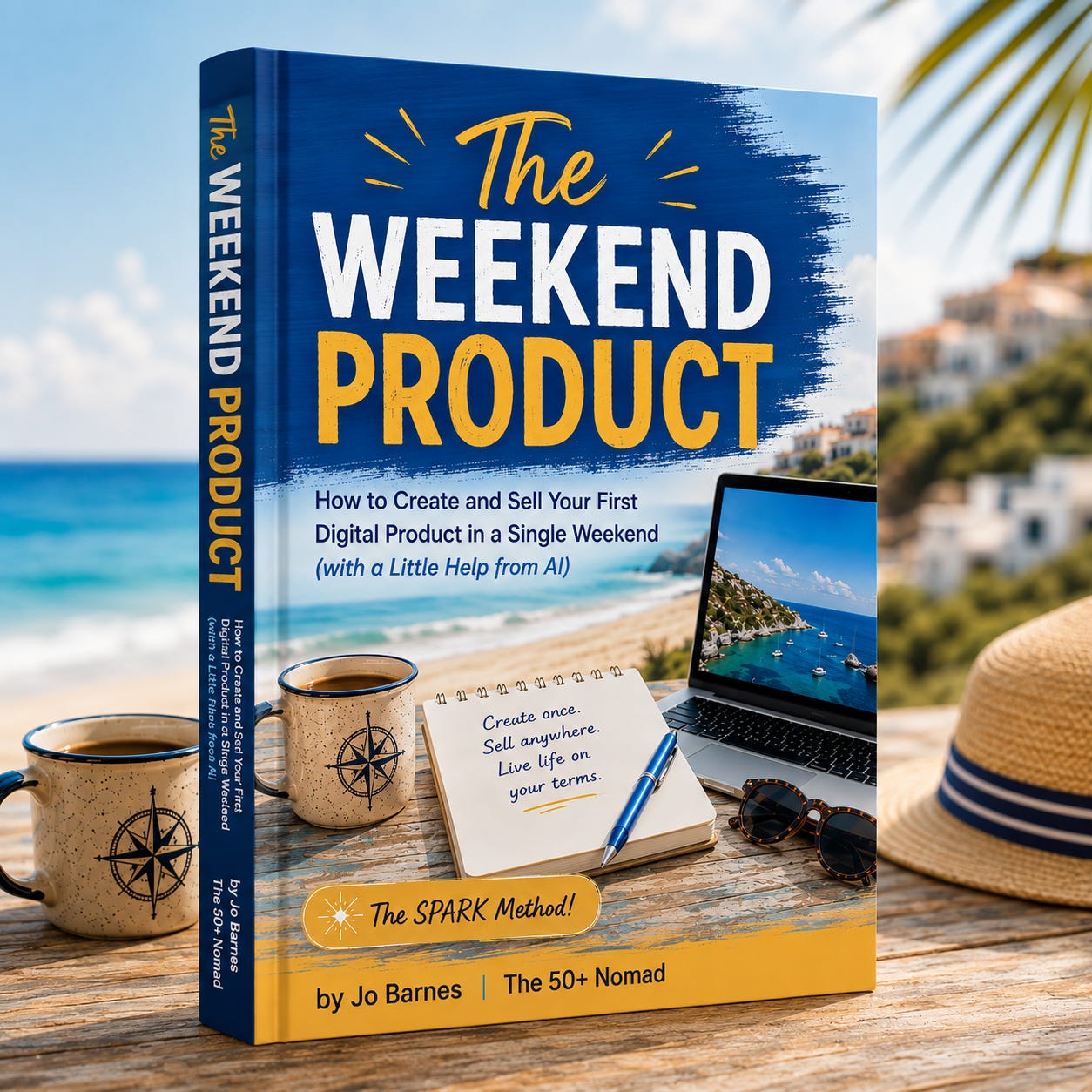
I’ve just built mine from the car, somewhere between Hope, Cache Creek & Chase, dodging the wildfire smoke on the way out of Vancouver, and recording into my phone as the road wound on.
I've just uploaded it to Gumroad, and it's live right now.
Here’s what’s inside:
How to find the one idea your audience will likely pay for, and how to check before you build a thing
The exact AI prompts I use to draft it fast, in your own voice
How to design and package it so it looks like someone was paid to make it (even if that someone is you, on a free Canva plan)
Where to sell it, what each platform costs, and how to set it up in an afternoon
How to write a sales page that does the selling for you
And how to promote it for two months without feeling like a used-car salesman
If you want it, you can grab it right now for a measly $7. That low price is completely deliberate, and it's exactly what I teach inside: start small, gather your first reviews, then put the price up. You're watching the method work in real time. In a couple of weeks it goes to $17.
Or, if you’re a paid subscriber, it’s already waiting for you in the Backpack, free, along with everything else I make.
And if you’re not a paid subscriber yet, come and join us today. You get everything in the Backpack, including this guide and every other PDF in there, because I’m doubling down on micro hustles, my friends. I’ll be adding a whole run of them for paid subscribers, all living in the Backpack. So come and grab it.
Either way, please don’t let this be another idea you nod along to and leave on the shelf. Open Canva, sketch something out, make the small thing, put a price on it, and let the world teach you the rest.
Mine was just $7, and I still think about that afternoon, sixteen years on.
Your first one is waiting.
Adventure never retires.
Jo 😊
I tried writing my article from the passenger seat of a car last week and ended up with a 36 hour bout of vertigo! Right before hiking the Narrows in Zion. 😬 Hope you have much better luck than that but just reading about it brought back memories…