


Yesterday afternoon, very decadently, Cerys (my daughter) and I were lying by the rooftop pool here in Vegas, sun on our faces, drinks in our hands, with the sounds of the strip in the distance.
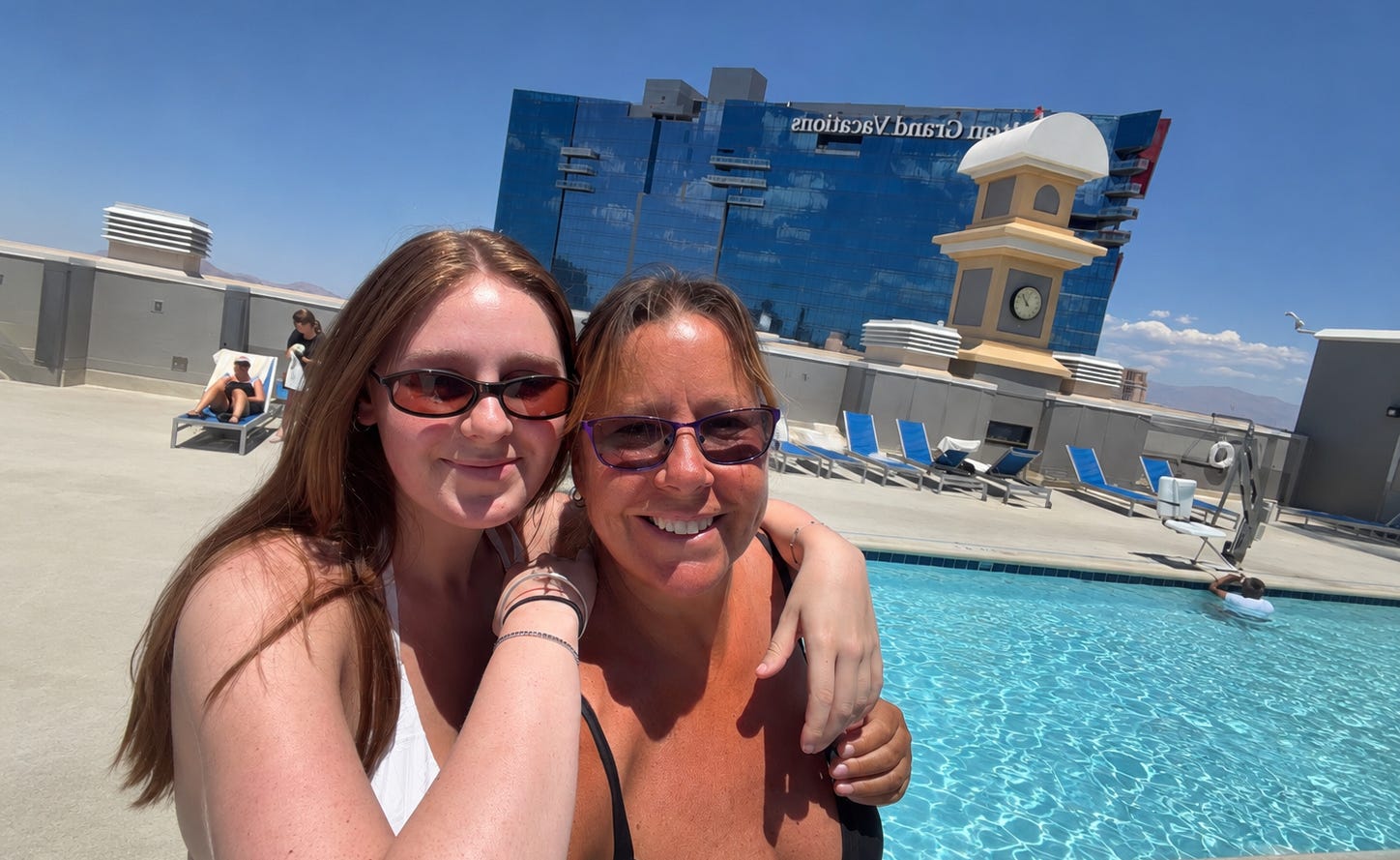
Cerys is (almost) 20 and studying music at college in London, so when she starts talking about how the music business works these days, I listen. (How the tides have turned - for the last 2 decades I’ve told her how the world works, now she’s the worldly one!)
She was telling me about how successful artists build loyal audiences these days.
“They stay in their lane,” she said. “They build a strong, distinctive sound. They give their audience exactly what they came for, again and again, until that audience knows them, trusts them, and feels devoted. And then, once they’ve earned the loyalty, they start to experiment. They branch out, evolve their sound, try different things, and by that point the audience will follow them anywhere.”
She’d just unknowingly summed up the single most important principle of audience-building, regardless of what you’re building.
The Gwen Stefani Example
On the night we arrived in Vegas, Rhett and I went to see No Doubt at the Sphere. It was the second-to-last night of their 18-show residency. They’d originally only had 12 nights booked but sold out, so had to add an extra 6 nights to meet demand.
(Confession: I’m not actually a huge No Doubt fan. I’m more of a Gwen fan. But, you’ll see, that’s actually part of the point.)
Because 18 sold-out nights at the Sphere in 2026, for a band marking the 30th anniversary of their most popular album ‘Tragic Kingdom’ - well, that doesn’t happen by accident.
If you’re unsure who I’m talking about, No Doubt built their audience in the 90s as a distinctive ska-punk band. Loud, fun, full of energy, with a very strong identity and what became a loyal fanbase.
Then in the mid-2000s, Gwen stepped out and made pop music. Hollaback Girl. Harajuku. The Voice. The fashion line. She wasn’t just the lead singer of a 90s ska-punk band anymore. She became a global cultural icon.
But she didn’t make that leap from nowhere. She made it from a platform of 15 years of building an audience inside a band that people loved.
The loyalty and trust was already there. Her new direction paid off because she’d earned the right to try it.
You See It Everywhere In Music
Once you start looking for it, the pattern shows up across the industry.
The Beatles spent four years as the loveable mop-tops before they attempted Sgt. Pepper’s. The experimental work paid off because the audience already trusted them as the band who made “She Loves You”.
Radiohead built their reputation as a guitar-rock band with The Bends and OK Computer. By the time Kid A arrived in 2000 with no guitars and electronic textures, some fans were horrified, but the core stayed. Radiohead became more, not less, important, because they’d earned the right to experiment.
Bruce Springsteen built his audience as a rock-and-roll storyteller with the E Street Band - big productions, anthemic live shows. Then in 1982 he released Nebraska, a stripped-back acoustic album recorded alone in his bedroom. No production, just him and a guitar. The audience came with him because by now they loved Bruce.
Look at the order in every one of these examples:
Lane first.
Loyalty second.
Experimentation third.
Why This Is Important For Us
Cerys was talking about musicians. But what she’d actually described is the architecture of every successful audience-driven business, brand, publication, or product line ever built.
It comes down to a core message, a core identity and a core promise.
The thing your audience knows you for.
What they show up expecting, and what’s true of you across every post, every episode, every product, every conversation and every note.
Without that core, the audience can never quite form, because there’s nothing for them to truly attach to.
They might enjoy a piece here and a video there, but they never become yours. They never quite know what you stand for, so they can never become devoted.
Imagine if No Doubt had made one song in their ska-punk sound, another in the grunge style of the early 90s, and another in the burgeoning pop of the late 90s, just because they couldn’t pick a lane and wanted to try a bit of everything.
They’d never have built an audience.
The musicians who build lifelong audiences understand this instinctively. So do the writers, the founders, the YouTubers, the coaches, and the brands that endure.
They pick the one thing they stand for, they hold it for years, and they become the person their audience trusts on that one thing.
The experimentation, the diversification, the cross-platform expansion, the new products, the off-piste topics, the side projects, all come later. After the loyalty.
What To Do About It
So before you throw your hands up in the air with frustration and say but I want to talk about travel and business (note to self), you can, as long as you know your defining message.
Example: This post is about audience building. Because my core topic, core message, core identity is ‘how to fund freedom and live your best life after 50’.
Defining message - “How to fund freedom.”
I started this post with the story of Cerys & I in the pool here in Vegas, and on Friday I wrote a post all about Vegas and guess what, Friday coming I’ll be sending out a post all about our nomadic life after 137 days on the road.
That’s because travel is the lifestyle. Funding freedom is the message.
So, if you’re building anything that depends on an audience, here’s what the principle looks like in practice.
Name your core message. One sentence. What do you stand for? What do you want your audience to associate you with? Get it onto paper before you write another post.
Make it visible. In your tagline, your about page, your first paragraph of every post. The reader should know within 10 seconds what they’ve landed on.
Hold the lane. Every post, every Note, every video should connect back to the core message. Not the same topic every time, but the same underlying theme. Different angles on the same one thing.
Let topics vary, but never the core. You can write about travel one day and family the next and business the day after. As long as each one is serving the lane, the variety strengthens you, not weakens you.
Don’t experiment until the loyalty is built. New formats, new genres, new directions are all fine. But save the big swings for after you’ve built the trust. Until then, the lane is what holds everything together.
When you veer off, come back fast. Everyone veers. Even the best of them. The lane isn’t a prison, it’s a centre of gravity. As long as you keep returning to it, the audience stays with you.
Believe me, this is a lesson I’m re-learning all the time, but get the order right, and one day you might find yourself selling out 18 nights at the Sphere 30 years after your biggest album.
Or, less ambitiously, you find yourself with a real audience of people who’ll follow whatever you do next, because they trust who you are.
The order is the same either way.
Right. Pool’s calling for more deep discussions!
Have a great Monday.
📍 Las Vegas, Nevada 🎰
Love this piece Jo and once again you delivered a fantastic message. I listened to it and read along, and it really hit home.
Your daughter is a smart one for sure! I think the hardest part of this concept is deciding what your lane is though... There are so many things I enjoy writing about and they all relate at least peripherally to my main storyline here. I think it's a matter of making sure it makes sense and the context is clear. Great read!