

I was listening to Ryan Daniel Moran on his podcast the other day, talking about his business, when something struck me about the way he approaches his marketing.
If you’re not familiar with Ryan, he’s an entrepreneur, investor and author of ‘12 Months to $1 Million’, a book that teaches people how to build a million-dollar e-commerce business.
He’s also a fascinating chap to follow because he talks about lots of different stuff.
One minute he’s discussing how to build a successful e-commerce brand, the next he’s talking about his family, where he’s travelling, people he’s meeting, investments he’s making or his BHAG (big hairy audacious goal) to buy the Cleveland Guardians baseball team.
He shares his thoughts on business, mindset, wealth, personal development and whatever else happens to be occupying his brain that particular week.
But underneath all those conversations, his niche & business is glaringly clear.
Ryan knows exactly what he’s selling, who he’s selling it to, and what he wants people to do when they come across his content.
His flagship offer is The One Percent, a high-ticket coaching programme designed to help entrepreneurs build successful e-commerce businesses.
His core philosophy is stupidly simple.
Develop four products, each selling for around $30, generate approximately 25 sales per product per day, and you’re looking at roughly $1 million in annual revenue.
Of course, there’s a lot more involved in building a successful business than that, and revenue isn’t profit, but it’s a KISS framework that people can instantly understand and work towards.
And that’s what Ryan teaches.
He writes books, records podcasts, sends emails, shares his experiences and talks about whatever interests him, but everything sits within a business built around helping entrepreneurs achieve a specific outcome.
Build a million-dollar e-commerce business.
His audience knows what he stands for, what he teaches and how they can work with him.
And he knows exactly where he wants to take them.
I love that.
Because there’s an important distinction between being able to talk about lots of different things and having a business that tries to be lots of different things.
Ryan has the freedom to explore a multitude of subjects because the commercial foundation underneath his content is so clear.
And it’s something we should all spend more time working on.
Start With The End In Mind
One of Stephen Covey’s most famous principles from ‘The 7 Habits of Highly Effective People’ is to begin with the end in mind.
It’s a philosophy I’ve come across a lot over my years in business, but listening to Ryan reminded me just how important it is when you’re building a business around content.
Because it’s incredibly easy (and very common) to get caught up creating content without being clear about what (or who) you’re creating it for.
You start a blog, a YouTube channel, a Substack publication or an Instagram account.
You write about things you’re passionate about, share your experiences, attract followers and gradually build an audience.
You celebrate your first hundred subscribers, then your first thousand.
You experiment with headlines, track your open rates, watch your engagement and spend a silly amount of time trying to figure out what the algorithms want from you.
All perfectly reasonable things to do.
But if your intention is to build a profitable business, there’s a crucial question that needs answering somewhere along the way.
What do you ultimately want these people to buy?
Because that answer influences almost everything else.
It determines who you’re trying to attract, what problems you’re helping them solve, the stories you share, the content you create and the relationship you build with your audience.
And the great thing is that once you’ve got that part clear, you can give yourself much more freedom with everything else.
The Interesting Thing About Substack
I love Substack. I love the simplicity of publishing, the conversations, the community and the fact that anyone with something interesting to say can start writing and potentially build an income from it.
But I think the platform’s subscription model makes it easy to approach building a business backwards.
The basic premise is simple.
Write about things you’re interested in, attract readers, build relationships and eventually invite people to become paid subscribers.
And for some creators, that’s a fantastic business model.
Journalists, researchers, specialist commentators, exceptional storytellers and people with highly engaged communities can build fab & highly profitable subscription businesses.
But there’s a huge difference between attracting people who enjoy reading your work and persuading those people to pay for it.
Let’s look at some numbers.
Suppose you charge $10 a month for a paid subscription.
With 100 paying subscribers, you’re generating $1,000 a month in gross recurring revenue.
With 500, you’re generating $5,000 a month.
And with 1,000, you’re generating $10,000 a month.
Sounds easy, right?
Yeah, not so much.
If you convert around 2–3% of your free subscribers into paying members, (which is what recent estimates suggest), you’ll need approximately 3,334 free subscribers to reach 100 paid members (at 3%).
To reach 500 paying members, you’ll need around 16,667 free subscribers.
And to reach 1,000 paying members, you’ll need 33,334 free subscribers. 😳
And that’s assuming you maintain that conversion rate, retain your paying members and continue attracting new readers.
The figures are illustrative, of course. Some publications convert much better, others much worse, and there are fees and taxes to consider.
But they demonstrate that:
Building a meaningful income from paid subscriptions requires either a substantial audience, a highly engaged audience willing to pay, or some combination of the two.
And as more people discover Substack and start publishing, attracting attention and persuading readers to part with their money isn’t likely to become easier.
None of this means paid subscriptions are a bad idea.
Far from it.
But if that’s the business model you’re choosing, I’d encourage you to start by asking why someone would pay you.
What are they getting that they can’t get from your free content?
Are you providing specialist knowledge, exclusive research, entertainment, access, community, practical resources or something else they value?
Why would they subscribe in the first place, and perhaps more importantly, why would they continue paying month after month?
Once you’ve answered those questions, you can start creating content that attracts people who are likely to value what you’re offering, rather than building an audience and hoping you’ll eventually figure out how to make money from it.
Your Content Isn’t Necessarily Your Product
Substack is built for this model, but it doesn’t have to be that way.
Your content can be the way people discover you, get to know you, learn from you and develop enough trust to buy something else.
That might be a book, a course, a digital product, a physical product, a software subscription or any number of other things.
You might even have a combination of income streams.
But having one clear primary offer gives your business a destination.
Think about Ryan again.
His emails aren’t all detailed tutorials about building e-commerce businesses.
Some are personal stories, some are philosophical reflections, some are practical business lessons and others are updates about things happening in his life.
But they’re being shared with an audience of people who are interested in entrepreneurship, wealth creation and building successful businesses.
And there’s a clear offer available for those who want his help.
He doesn’t need to sell in every email, and he doesn’t need every piece of content to be a step-by-step business tutorial.
His audience already understands what he does.
Think about how freeing that is!
As long as you know who you’re talking to and what you’re ultimately helping them achieve, you can be incredibly broad in what you write about.
And because you’re clear about the value you offer, you’ll naturally find connections between the stories you share, the subjects you explore and the things your audience wants to achieve.
The 50+ “Digital” Nomad
This brings me to a change I’ve made this week.
As you likely know by now, I’ve spent the last 16 years building online businesses while travelling the world.
I’ve built successful brands, not so successful brands, and done so while traveling, living abroad & raising my daughter in Phuket.
I’ve experienced all the wonderful highs and occasionally spectacular lows that come with being an entrepreneur.
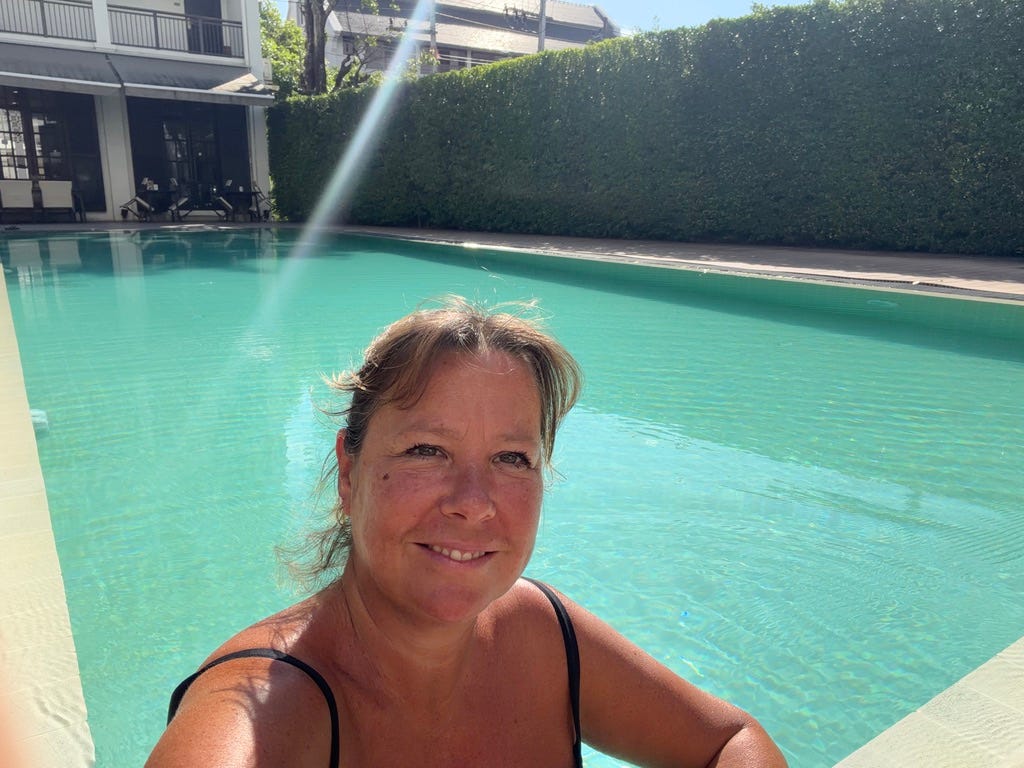
And right now I’m recording this article on my phone while walking up and down in a swimming pool in Chiang Mai, Thailand.
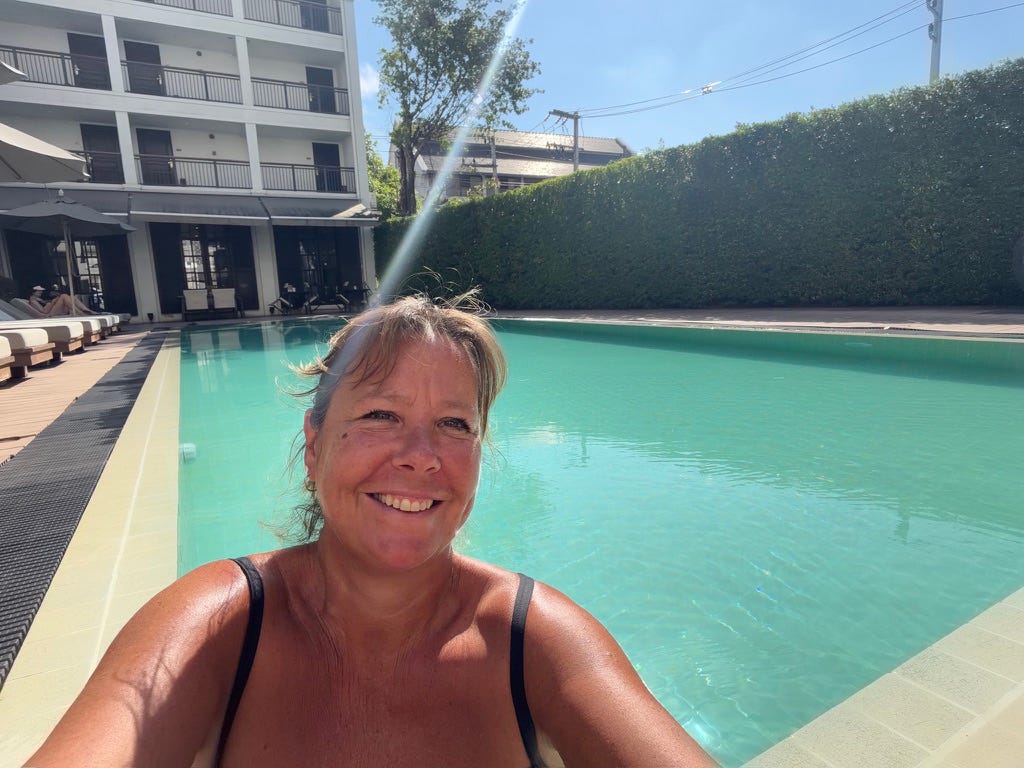
Which probably tells you everything you need to know about why I love this lifestyle so much. 😂
I’m 54 years old, I’m a full-time digital nomad, and I’m currently building an e-commerce business while growing an audience of people over 50 who want to create more freedom, purpose and adventure in their lives.
Yet when I originally launched The 50+ Nomad, I deliberately left the word ‘Digital’ out of the name.
Why?
Because over the years, I’ve developed a huge aversion to the whole ‘make money online’ industry.
I’ve seen far too many promises of instant riches, passive income while you sleep and six figures from a laptop on a beach (albeit I regularly work from my laptop on beaches 😂).
And I suppose I just didn’t want to be associated with that whole snake-oil salesman side of the internet.
But at the end of the day, the terminology doesn’t change what I actually do.
Which is…
I build online businesses.
I earn money while travelling.
I work on my laptop on beaches.
I record articles into my phone in swimming pools.
I even had Claude create a list of draft emails in my Gmail to send to gift guide publications while laying on the sunbed.
And I love helping other people figure out how to use their skills, knowledge, interests and experiences to create an income that gives them more freedom over how and where they live. (Without a snake-oil salesman in sight!)
Call it making money online, building a digital business, becoming a solopreneur or creating portable income.
It’s all part of the same world.
And listening to Ryan talk about his business got me thinking about how I could make the commercial side of my own publication equally clear.
So this week I’ve put the word Digital back into the brand.
I’m owning it. I am a 50+ Digital Nomad.
Same me, same adventures, same three subjects I love writing about. (Funding freedom, life on the road and ageing disgracefully.)
But now I’m getting super clear on who I want to reach & how I can help them.
Rather than trying to appeal to people who love to travel, or to 50 plussers who want a bigger, bolder second act. I’m specifically talking to 50plussers who want a bigger, bolder second act, love to travel and want to know how to build an online business that gives them the freedom to make it happen!
Essentially people over 50 who want to become their own version of digital nomad, whether that means travelling full-time, spending three months of the year exploring somewhere new, escaping the winter or simply creating an income that allows them to work from wherever they choose.
And I already have something that can help them do exactly that.
One Clear Offer
Over the years, I’ve created crazy amounts of content and training about building online businesses.
Courses, workshops, guides, videos, workbooks, resources. You name it.
And I have a bloody fab course (if I do say so myself) already in my content library!
How to Become a Digital Nomad in Your 50s and Beyond.
It’s a comprehensive, practical course designed to help someone go from dreaming about a location-independent lifestyle to understanding how they can start creating one.
It covers the different ways to generate portable income, how to choose a business model that suits your skills and circumstances, how to start building your freedom funding income and how to prepare for the practical realities of life on the road.
There are video lessons, practical exercises and supporting resources to help people work through the process rather than simply watch a few videos and hope for the best.
I’ve had it tucked away amongst my other products and membership offerings, but I’ve decided to bring it front and centre and make it the flagship offer for The 50+ Digital Nomad.
Because that’s the transformation I want to help people achieve.
I want someone in their 50s or 60s who’s sitting at home dreaming about spending six months in Thailand, travelling around Europe or finally having the freedom to explore the world to understand that there are practical ways to make that happen.
They don’t necessarily need to build a million-dollar business.
They might only need an extra $1,000 or $2,000 a month.
They might want to replace their employment income, supplement their pension or create a small business that allows them to work a few hours a day while travelling.
There are lots of different ways to approach it. And I’ve spent enough years doing this to know that there isn’t one perfect business model for everyone.
So that’s what my course is designed to help people figure out.
Will it become a hugely successful flagship product?
I’ve no idea.
I’ve built enough businesses to know that creating something valuable and successfully selling it are two different challenges.
But I know what I’m offering, who it’s designed for and what I want it to help people achieve.
And that gives me a very clear starting point.
The Freedom To Talk About More Than One Thing
Which means I can talk about all the things I love to talk about!
Funding freedom tips, building my own online businesses and sharing my highs & lows, life on the road as a 50+ digital nomad & of course the hilarious realities of getting older while still acting like a 25 year old! (Go me! 😂)
Because becoming a digital nomad after 50 is a much bigger topic than earning money online.
It’s about creating the freedom to live your best life, having adventures while you’re fit and healthy enough to enjoy them, and finding purpose and excitement in a stage of life that society still seems determined to associate with slowing down.
And that’s what I want to write about.
The content can be personal, practical, philosophical, funny, even a bit silly, as long as the audience and the outcome remain the same.
Which is exactly what I admire about Ryan’s approach.
Know Your Who, Your What and Your Why
So it’s time to put this all into practice, and these are the 3 things I think it’s worth getting very clear about.
1. What are you selling?
Start with the commercial destination.
Are you building a paid publication? Selling courses? Creating digital products? Offering a service? Selling physical products?
You can absolutely have multiple income streams, but I’d encourage you to identify one primary offer to begin with.
Something you can build your content and marketing around.
And if you’re planning to sell paid subscriptions, remember that the subscription itself isn’t the value.
The value is what people receive in exchange for paying you.
So get very clear about what that is.
2. Who are you selling it to?
This is where FOMO kicks in.
Am I nervous I’ll lose people as they won’t associate with the term ‘digital nomad’? Of course. But there comes a point you have to drive your stake in the ground.
We can’t keep trying to appeal to everyone because we don’t want to exclude potential customers.
The more people we try to reach, the harder it becomes to create a message that makes any one person feel understood.
Remember your niche isn’t simply a subject. It’s a person.
Someone with particular interests, ambitions, problems, frustrations and desires.
Someone who can read your content and think, ‘Bloody hell, this person understands exactly what I’m trying to do.’
If you’re not sure where to start, read this:

And remember, choosing a target audience doesn’t mean nobody else can buy from you.
It just means you know who you’re speaking to when you create your content.
3. Why should they buy from you?
This is where your experience, personality, expertise and perspective come into play.
There are thousands of people teaching online business, thousands of travel bloggers, and thousands of people writing about life after 50.
And there are probably thousands of people who could create a digital nomad course.
But they haven’t all spent 16 years building businesses while travelling the world.
They haven’t raised a daughter in Phuket, found a cheese block in the drawer instead of the fridge, hiked a national park in Brazil with dodgy knees & a group of 20 year olds or grown a 7 fig Amazon business (just thought I’d pop that one on the end there! 😂)
And they certainly don’t all share my obsessive belief that life after 50 should involve a boat load more adventure and far less waiting for someday.
That’s what makes my perspective different.
And the same applies to you.
Your experiences, your knowledge, your personality and your way of looking at the world are all part of what makes your business worth paying attention to.
You don’t need to be the only person offering something.
You need to give the right people a compelling reason to choose you.
Now Work Backwards
Once you know what you’re selling, who you’re selling it to and why someone should choose you, creating content becomes a much more deliberate process.
Instead of sitting down every morning wondering what on earth to write about, you can start thinking about the people you’re trying to help.
What are they struggling with?
What do they want to achieve?
What do they need to understand before they’re ready to take the next step?
What stories, experiences or ideas could help them see what’s possible?
And how can you make their journey a little easier?
You can still write about things that interest you. You can still experiment, follow your curiosity and share the occasional completely unrelated story.
You don’t have to turn your publication into one long sales pitch.
But you’ll have a much clearer understanding of how your content supports the business you’re trying to build.
And that, my friend, is the real beauty of starting with the end in mind.
It gives you direction without taking away your creativity.
A Little Exercise Before You Go
If you’re currently building an audience, a publication or an online business, grab a notebook or your notes app, and complete these three sentences.
My business makes money when people…
The people most likely to buy from me are…
I can attract and help those people by sharing…
Don’t overcomplicate it.
If you’re struggling with the first sentence, spend some time thinking about your business model and what you’re ultimately offering.
If you’re struggling with the second, think more deeply about the person who would benefit most from what you sell.
And if you’re struggling with the third, consider what that person needs to know, understand or believe before they’re likely to become a customer.
Because you can spend years creating wonderful content, attracting followers and building an audience, but if your intention is to make money from it, you need to know where you’re taking those people.
And once you do, you might find that you have far more freedom to create the content you love.
I certainly intend to.
Now, if you’ll excuse me, I’ve got a few more lengths of this swimming pool to walk before I head upstairs and get back to building my e-commerce business.
All in a day’s work for a 50+ digital nomad. 😂
P.S. Ready to build a business you can run from anywhere in the world, whether that’s your kitchen table or a beach in Fiji? 🌴 My course, How to Become a Digital Nomad in Your 50s & Beyond, shows you how, step by step, with 4 free bonuses and a double money-back guarantee.
Writing it from a pool in Chiang Mai is peak 50+ Nomad! That 33,334 free subscribers for 1,000 paid maths is such a useful reality check. Knowing the one thing you want people to buy first really does make everything else easier!